40%
Potential demand charge reduction with peak shaving BESS strategy
100+
MWh scalable BESS capacity per campus deployment
0 ms
Switchover time from grid to BESS during power events
20+
Year asset life for utility-scale lithium iron phosphate BESS systems
The Missing Layer
What BESS Does for
a Data Center
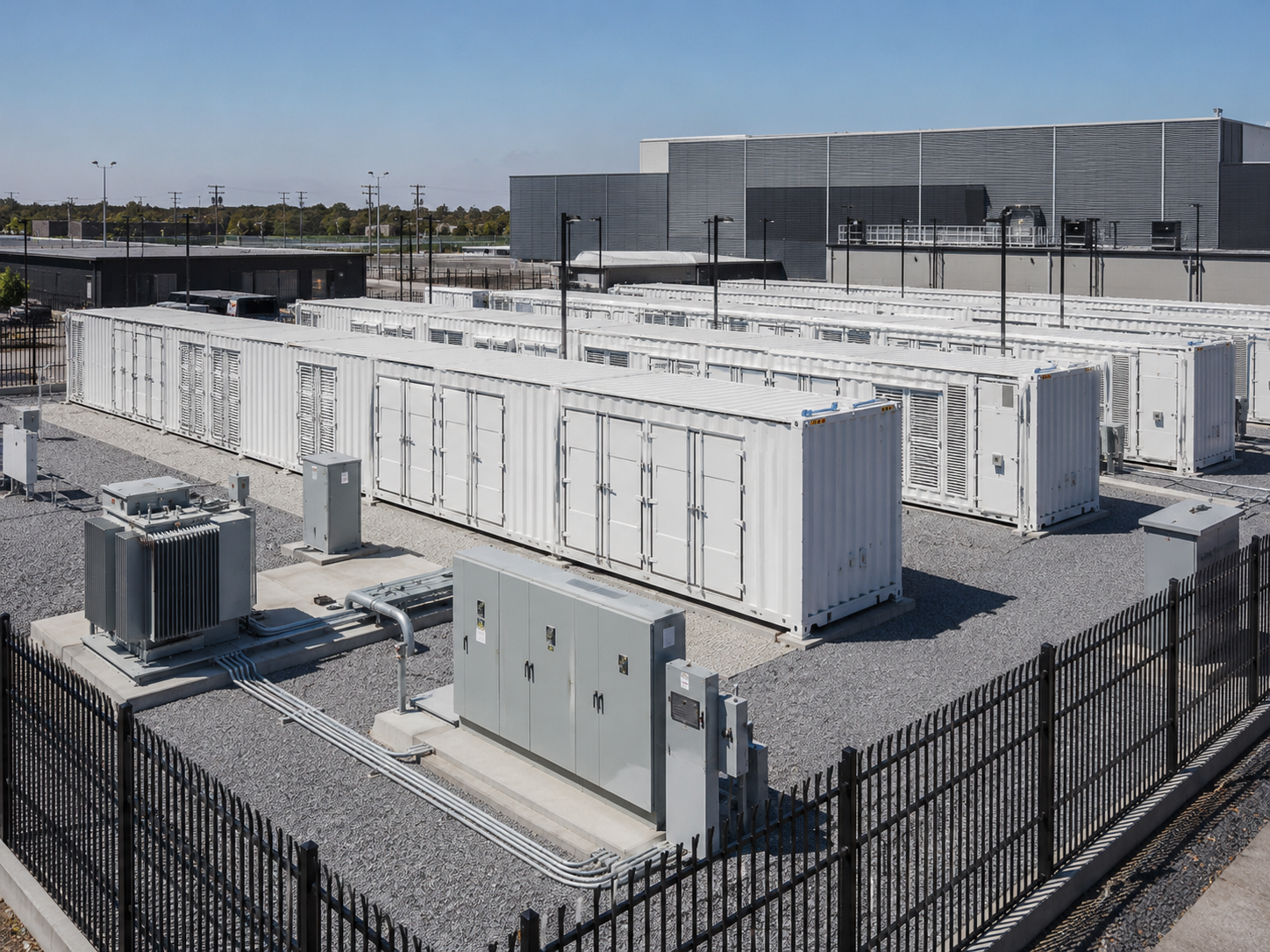
Battery Energy Storage Systems are utility-scale lithium iron phosphate battery installations deployed at the site level — behind the meter, between the utility interconnect and the data center load. They are not backup generators. They are intelligent energy buffers that manage the relationship between the data center and the grid in real time.
AI data centers are among the most demanding grid loads ever built. A single rack of GPU servers draws 40–80 kW continuously. A 60 MW campus represents the equivalent demand of 40,000 Texas homes. Without a BESS layer, that load hits the grid unmanaged — creating instability, triggering utility penalties, and making the facility a liability to the communities it operates in.
LegacyGrid structures every data center partnership with BESS as a non-negotiable infrastructure layer — not an add-on. The battery system is sized, sited, and contracted as part of the original deal structure.

The Four Functions of Data Center BESS
Why Every Campus Needs
All Four Layers
A properly structured BESS deployment serves four simultaneous functions. Each one independently justifies the investment. Together, they make the data center a better grid citizen, a lower-cost operator, and a more resilient facility.
FUNCTION 01
Grid Stability & Load Buffering
AI data centers draw massive, variable power loads. Without site-level battery storage, every GPU cluster spin-up hits the grid directly — creating frequency instability, demand spikes, and utility penalties. LegacyGrid's BESS layer absorbs those transients, smoothing the load profile before it ever reaches the substation.
FUNCTION 02
Demand Charge Reduction
Utility demand charges are calculated on peak 15-minute intervals. A single unmanaged AI inference burst can set the demand charge for an entire month. BESS discharges during peak windows, flattening the demand curve and dramatically reducing the facility's monthly utility bill.
FUNCTION 03
Backup Power & Continuity
Data centers cannot tolerate power interruptions. LegacyGrid's BESS architecture provides seamless bridge power during grid events — covering the gap between utility outage and generator startup, and sustaining critical loads during extended grid instability without relying on diesel alone.
FUNCTION 04
Grid Services & Revenue
A properly configured BESS system is not just a cost center — it is a revenue asset. LegacyGrid structures BESS deployments to participate in ancillary services markets: frequency regulation, spinning reserve, and demand response programs. The battery earns while the data center operates.

Deployment Architecture
How LegacyGrid
Structures BESS
LegacyGrid's BESS deployments use containerized lithium iron phosphate (LFP) battery systems — the same chemistry used by utility-scale grid operators worldwide. LFP is chosen for its thermal stability, 20+ year cycle life, and suitability for continuous cycling in grid services applications.
Each deployment is sized to the specific campus load profile, utility interconnect capacity, and grid services market. LegacyGrid works with the data center developer, the utility, and the ISO/RTO to ensure the BESS system is properly interconnected, metered, and enrolled in applicable grid services programs from day one.
Ownership structures are flexible — the BESS can be utility-owned, developer-owned, or structured as a school-owned asset under a lease arrangement in HBCU partnership deals, creating an additional long-term revenue stream for the institution.
Deployment Specifications
Deployment Format
Containerized BESS units — scalable from 1 MWh to 100+ MWh
Integration Point
Site-level, behind the meter, at the utility interconnect
Grid Services
Frequency regulation, spinning reserve, demand response
Backup Coverage
Bridge power from grid event to generator synchronization
Demand Charge Strategy
Peak shaving on 15-minute demand intervals
Applicable Markets
ERCOT, PJM, MISO, CAISO, and other ISO/RTO markets
Ownership Models
Utility-owned, developer-owned, or school-owned with lease structure
Applicable Sites
New data center campuses, HBCU land partnerships, industrial retrofits
BESS in HBCU Land Partnerships
The Battery System
Belongs to the School
In LegacyGrid's HBCU land partnership model, the BESS system is not just an infrastructure component — it is a negotiated asset. LegacyGrid structures deals where the institution retains ownership of the battery system, leasing capacity to the data center operator and earning grid services revenue independently.
This means the school earns from the land lease, earns from the BESS capacity lease, and earns from grid services participation — three separate revenue streams from a single infrastructure partnership, without paying a dollar upfront.
Land Lease Revenue
Base lease payments from the data center developer for use of campus land.
BESS Capacity Lease
The school owns the battery system and leases capacity to the data center operator.
Grid Services Revenue
The school's BESS participates in ERCOT ancillary services — frequency regulation, spinning reserve, demand response.
Compute Access Credits
Negotiated GPU compute credits for student research and institutional AI programs.
Workforce Pipeline
Paid student internships and apprenticeships in battery operations, grid management, and data center infrastructure.
Texas Grid Context
ERCOT Makes BESS
Especially Critical
Texas operates on the ERCOT grid — an isolated grid with limited interconnections to neighboring systems. ERCOT has experienced well-documented stress events, and the grid is absorbing unprecedented new load from AI data centers, Bitcoin mining, and industrial electrification simultaneously.
A 60 MW AI data center without BESS is a direct, unmanaged draw on ERCOT. During peak summer demand — when the grid is already stressed — that facility becomes a liability. ERCOT's ancillary services markets are specifically designed to compensate assets that help stabilize the grid. A properly enrolled BESS system turns that liability into a grid asset.
LegacyGrid's Phase 1 focus on the PVAMU corridor in Waller County is directly informed by this reality. The Waller County–Hockley corridor sits in a zone where ERCOT has identified significant transmission constraints. A BESS-equipped data center campus in that corridor does not just serve the data center — it serves the grid.
Build It Right the First Time
Every LegacyGrid Campus
Includes BESS
LegacyGrid does not structure data center deals without a BESS layer. If you are evaluating a campus-scale AI infrastructure opportunity — at an HBCU, a university system, or an industrial site — the battery storage strategy is part of the conversation from day one.