Grid-Scale Battery Storage Is Becoming an Infrastructure Discipline—Not a Product Decision
The decisive work happens across the full delivery system: equipment, site, utility coordination, controls, commissioning, safety, operations, and community context.
LegacyGrid AI Editorial · August 26, 2026 · 8 min read

Utility-scale storage is a coordinated site, grid, controls, and operations system—not a container purchase.
Delivery, Not Just Equipment
Grid-scale battery storage is increasingly discussed as if it were a simple procurement choice: select a container, select an inverter, procure units, and place them on a site. That view is incomplete. A functioning battery energy storage system is a coordinated infrastructure program whose result depends on how equipment, civil works, protection systems, controls, utility requirements, commissioning, emergency planning, and operations are designed to work together.
The scale of the sector makes that distinction more important. The U.S. Energy Information Administration reported that, at the end of 2023, U.S. electricity utilities operated 575 batteries with collective capacity of 15,814 MW and expected 35,953 MW of additional capacity by the end of 2028 from utility-reported plans. EIA also identified arbitrage and grid-reliability services among reported uses. [1]
The question is not simply, “Which battery should we buy?” The owner-side question is, “What complete operating system must be in place for storage to serve the site, support the grid, and remain governable over its life?”
From Factory to Operating Asset
Public manufacturer materials can make deployment look linear: equipment leaves a factory, reaches a site, is installed, and connects to the grid. That sequence matters, but each transition introduces technical and organizational interfaces. Tesla, for example, describes Megapack as an integrated utility-scale storage system and highlights factory integration, installation support, controls, and commissioning-related services. Those statements describe one vendor’s offering; they do not eliminate the owner’s responsibility to verify site, utility, safety, and operating requirements. [2]
Battery blocks, power-conversion systems, transformers, switchgear, enclosures, thermal management, and controls must be selected as an interoperable system.
Civil design, drainage, access, fire lanes, setbacks, fencing, communications, and constructability determine whether the concept can become an operating asset.
The serving utility, protection scheme, interconnection study, operating limits, and meter/control interfaces govern how the storage system can participate.
Commissioning, monitoring, maintenance, emergency coordination, warranty responsibilities, and lifecycle decisions determine whether performance remains verifiable.
Interconnection Is a Project Workstream
Interconnection should not be treated as the final sign-off after equipment selection. The U.S. Department of Energy’s Distributed Energy Resource Interconnection Roadmap identifies the growing need to accommodate storage systems, large loads, and hybrid facilities on distribution and sub-transmission networks. Its goals emphasize data access and transparency, better processes and timelines, economic efficiency, and grid reliability, resilience, and security. [3]
For an AI infrastructure project, this means storage decisions have to be tested against the actual power pathway: utility service, interconnection point, substation or transformer interfaces, power-conversion equipment, BESS yard, controller, and designated priority loads. Battery storage can be a valuable resilience and flexibility layer. It does not remove the need to establish the appropriate grid relationship, capacity, operating limits, and approvals for the site.
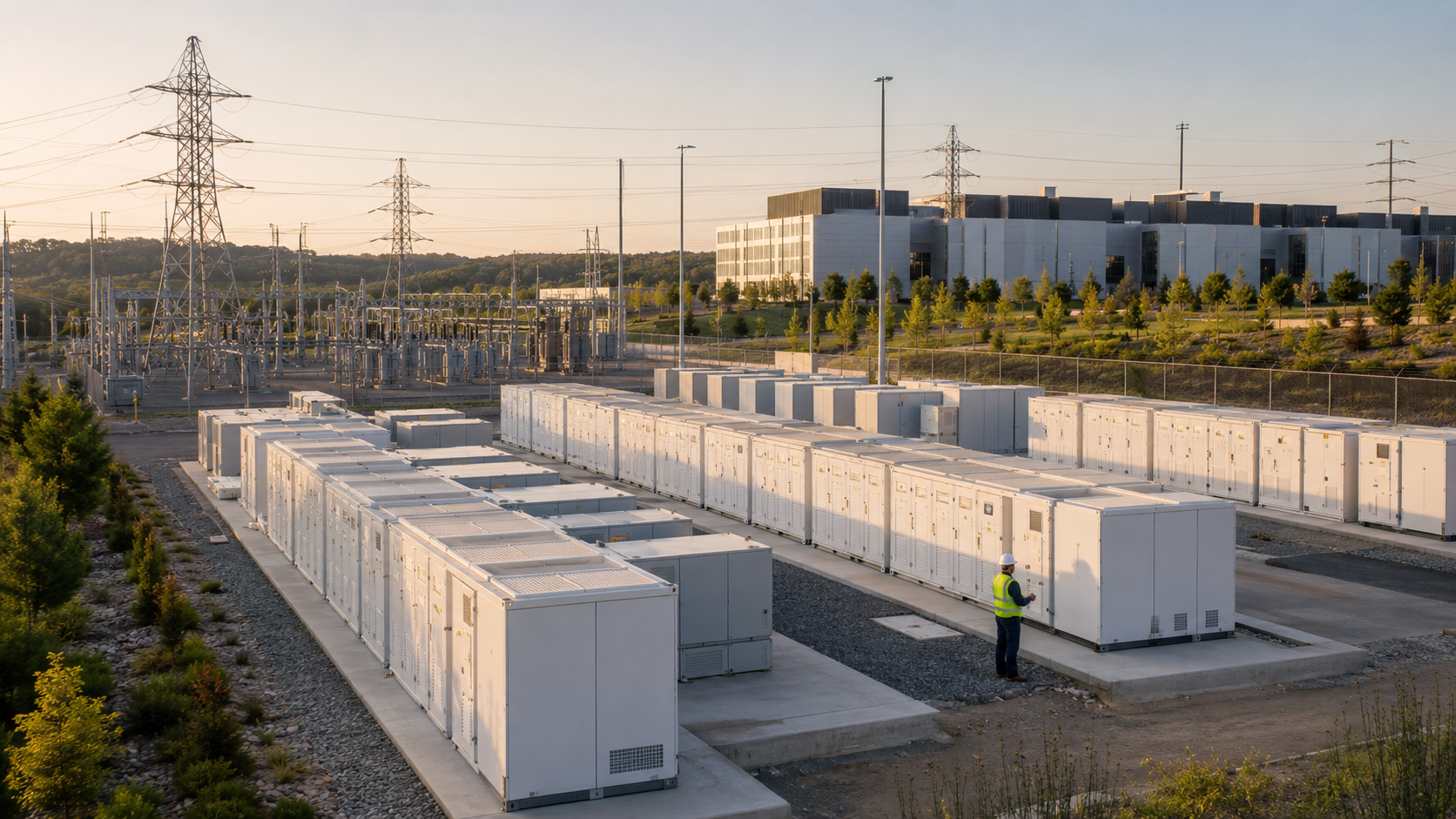
Conceptual planning context only. Actual siting, capacity, equipment selection, and operating rights require site-specific engineering and utility review.
What an Owner Should Ask Before Selecting a Platform
A useful decision process starts with the intended operating role rather than a product name. Is the system being evaluated for peak management, critical-load continuity, renewable integration, demand response, ancillary services, a community-resilience objective, or a combination of roles? Each objective changes the required duration, control strategy, interconnection pathway, service agreement, and evidence that must be reviewed.
Document the priority loads, operating modes, duration assumptions, control objectives, and constraints before requesting proposals.
Confirm utility, protection, communications, civil, safety, and operations interfaces rather than assuming a standard container layout fits the site.
Ask for studies, datasheets, warranties, control architecture, emergency procedures, commissioning plans, and responsibility matrices.
Advance only when the required evidence supports the intended use case, community commitments, and owner governance terms.
The Community Question Is Part of the System
At a campus or community-oriented AI infrastructure site, a BESS conversation should include more than the host facility. Owners and public stakeholders need to understand what the system is intended to protect, when it may operate, what constraints apply during peak or emergency conditions, and whether any public-benefit concept is actually supported by the controls, agreements, and capacity allocation. A statement that storage will “help the community” is not an operating plan.
LegacyGrid AI’s planning position is therefore owner-side and evidence-led: storage may strengthen a broader clean-energy and resilience strategy when it is evaluated with the utility relationship, site conditions, controls, documented priority loads, and enforceable governance. No particular vendor or configuration is implied by this article.
Editorial Boundary
This article is an educational planning analysis, not an equipment recommendation, an interconnection determination, a safety plan, or a representation that a specific project is feasible. Actual BESS development requires qualified engineering, utility coordination, authority-having-jurisdiction review, and project-specific contractual, commercial, and operating agreements.
Frequently Asked Questions
Does battery storage replace utility power? No. Storage can support defined operating objectives, but its role and limits must be assessed with the serving utility and relevant interconnection process.
What is the first decision? Define the use case and priority loads, then test the required site, utility, controls, safety, and operations evidence before selecting a platform.
Is this an endorsement of Tesla or any other supplier? No. Tesla is referenced as a public example of a utility-scale storage provider. LegacyGrid AI remains vendor-neutral unless a written authorization states otherwise.
OWNER-SIDE NEXT STEP
Use a structured readiness conversation to identify the evidence and decisions required before a storage concept advances into procurement or interconnection work.
References
[1] U.S. Energy Information Administration, “Utilities report batteries are most commonly used for arbitrage and grid stability,” June 25, 2024.
[2] Tesla, “Megapack — Large-Scale Energy Storage.” Vendor product information; cited for Tesla’s descriptions only.
[3] U.S. Department of Energy, “DOE Distributed Energy Resource Interconnection Roadmap.”