Tesla Megapack 3 Is Now Built in Texas. Here Is What It Means for AI Data Center Infrastructure.
Tesla's Brookshire Megafactory is 25 miles from PVAMU. The Megapack 3 changes the BESS deployment equation — and LegacyGrid AI is paying close attention.
LegacyGrid AI Editorial — August 10, 2026

BROOKSHIRE, TEXAS — AUGUST 2026
The News
Tesla Just Started Building Megapack 3 in Waller County
On August 6, 2026, Tesla confirmed that Megapack 3 production has begun at its new Megafactory in Brookshire, Texas. The facility went from groundbreaking to production in 16 months and is designed to produce 50 GWh of Megapack 3 per year — making it potentially Tesla's largest energy storage manufacturing site in the world.
Brookshire is in Waller County. That is the same county where Prairie View A&M University sits, 25 miles to the northwest. The same county where Serverfarm has been advancing AI infrastructure development. The same county that LegacyGrid AI has identified as the Phase 1 engagement zone for HBCU-anchored AI infrastructure in Texas.
This is not a coincidence. Waller County is emerging as a genuine AI infrastructure corridor, and the presence of a 50 GWh BESS manufacturing facility in the same county changes the supply chain equation for any project in that corridor.
What Changed
Megapack 3: The Three Numbers That Matter
The headline number is 5 MWh per unit — up from 3.9 MWh on the Megapack 2 XL. That is a 28% increase in energy density in the same physical footprint, achieved by moving to a larger 2.8-liter cell format. For a project requiring 500 MWh of BESS, that means 100 Megapack 3 units instead of 128 Megapack 2 XL units — fewer pads, less land, less wiring.
The second number is 78% — the reduction in thermal-system connection points compared to the previous generation. Liquid-cooled BESS systems fail at connections. Fewer connections means fewer failure points, less maintenance labor, and better long-term reliability. At grid scale, reliability is the whole game.
The third number is 20 — as in 20 business days to deploy 1 GWh using the Megablock. The Megablock bundles four Megapack 3 units (20 MWh) with the transformer and switchgear already factory-integrated. The medium-voltage wiring that used to happen in the field — the slowest and most expensive part of building a battery farm — now happens indoors at the factory. Tesla says this cuts installation time by 23% versus the current approach.
"Megapack 3 is officially rolling off the line at our newest Megafactory in Brookshire, Texas. The factory went from groundbreaking to operation in just 16 months and has a designed capacity of 50 GWh/year dedicated to Megapack 3." — Tesla Megapack, August 6, 2026
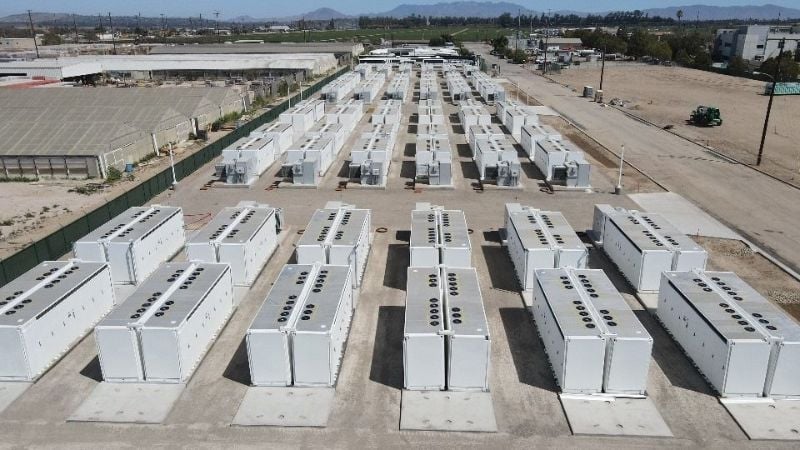
TESLA MEGAPACK DEPLOYMENT — GRID-SCALE BESS
The Comparison
Megapack 3 vs. Sungrow PowerTitan 2.0: What LGAI Is Evaluating
The Megapack 3 is not the only credible BESS platform for the LGAI reference case. Sungrow — the world's largest inverter manufacturer and a top-three global BESS supplier — has published a comprehensive safety white paper for its PowerTitan 2.0 platform, specifically written to UL standards for the North American market. Both platforms deserve serious evaluation.
The technical comparison is closer than most people expect. Both use LFP chemistry — the correct choice for community-adjacent deployments because LFP fundamentally eliminates the thermal runaway chain reaction risk that plagues NMC chemistry. Both use liquid cooling. Both have multi-level fire suppression. Both support grid services including peak shaving, frequency regulation, and islanded operation.
The key differences are supply chain and cost. Tesla's Brookshire factory is now producing Megapack 3 in Waller County — which means local supply chain, shorter delivery lead times, and potential for direct procurement relationships for Texas projects. Sungrow manufactures in Hefei, China, with a North American distribution and service network. Sungrow typically prices 15–25% below Tesla at scale, which on a 500 MWh project represents a significant capital cost difference.
There is one important caveat on Tesla's cost structure. Tesla has reported lower gross margins on its energy business due to tariffs on imported LFP cells — and its own domestic cell production is not yet close to 50 GWh. If tariff conditions change, Tesla's cost advantage from domestic manufacturing could be partially offset by cell sourcing costs.
| Parameter | Tesla Megapack 3 | Sungrow PowerTitan 2.0 |
|---|---|---|
| Cell chemistry | LFP (2.8L cell) | LFP (314Ah) |
| Capacity per unit | 5 MWh | ~5 MWh |
| Cooling | Liquid | Liquid |
| Fire suppression | Multi-level | Perfluorohexanone + aerosol |
| Grid integration | Megablock (transformer + switchgear) | Bi-directional PCS + transformer |
| UL 9540 certified | Yes | Yes |
| Manufacturing location | Brookshire, TX (50 GWh/yr) | Hefei, China (global) |
| Relative cost at scale | Higher (tariff pressure on cells) | 15–25% lower typically |
| U.S. service network | Yes | Yes |
The LGAI Position
What This Means for the Community Grid Asset Model
The LGAI Community Grid Asset reference case requires 100 MW / 500 MWh of BESS to support a 60 MW AI data center while maintaining a 20 MW / 80 MWh community reserve for four hours. At 5 MWh per Megapack 3 unit, that is 100 units — or 25 Megablocks. Tesla says 1 GWh deploys in 20 business days using Megablocks. That means the full 500 MWh BESS for the LGAI reference case could be installed in approximately 10 business days of field work, with the transformer and switchgear already integrated at the factory.
That is a fundamentally different deployment timeline than what was possible with previous BESS generations. And it matters for the community grid asset argument. The faster a BESS system can be deployed and commissioned, the sooner it can begin providing grid services to the surrounding community — peak shaving, frequency regulation, and backup power for critical loads during outages.
The Brookshire factory's location in Waller County is also strategically significant. A PVAMU-anchored AI infrastructure project in the same county as Tesla's 50 GWh Megafactory has a natural supply chain argument: locally manufactured BESS, shorter logistics chain, and a potential relationship with the manufacturer that a project in another state would not have.
LGAI does not endorse any single BESS supplier. The Megapack 3 and Sungrow PowerTitan 2.0 are both technically viable for the reference case. The selection decision depends on supply chain, certification timeline, cost, and the specific requirements of the utility interconnection — all of which are evaluated as part of the LGAI Domain B assessment. What the Megapack 3 announcement confirms is that the technology is ready, the supply chain is local, and the deployment timeline is achievable.
THE LGAI FRAMEWORK RESPONSE
LegacyGrid AI evaluates BESS platforms as part of the Domain B Energy Contribution & Flexibility assessment in the LGAI Readiness Standard. Every platform — Tesla, Sungrow, or any other supplier — must demonstrate LFP chemistry, UL 9540/9540A/1973 certification, multi-level fire suppression, grid services capability, and a North American service network before it qualifies for the LGAI reference case. The Community Grid Asset model is platform-agnostic. The standard is not.