Nashville Shows Why Cities Need a Modern Data Center Readiness Framework
Nashville's current data center debate is not just a local zoning dispute. It is a national warning sign — and a practical case for why every city needs a readiness framework before the next proposal arrives.
Carl Adams, Founder — LegacyGrid AI · July 2026
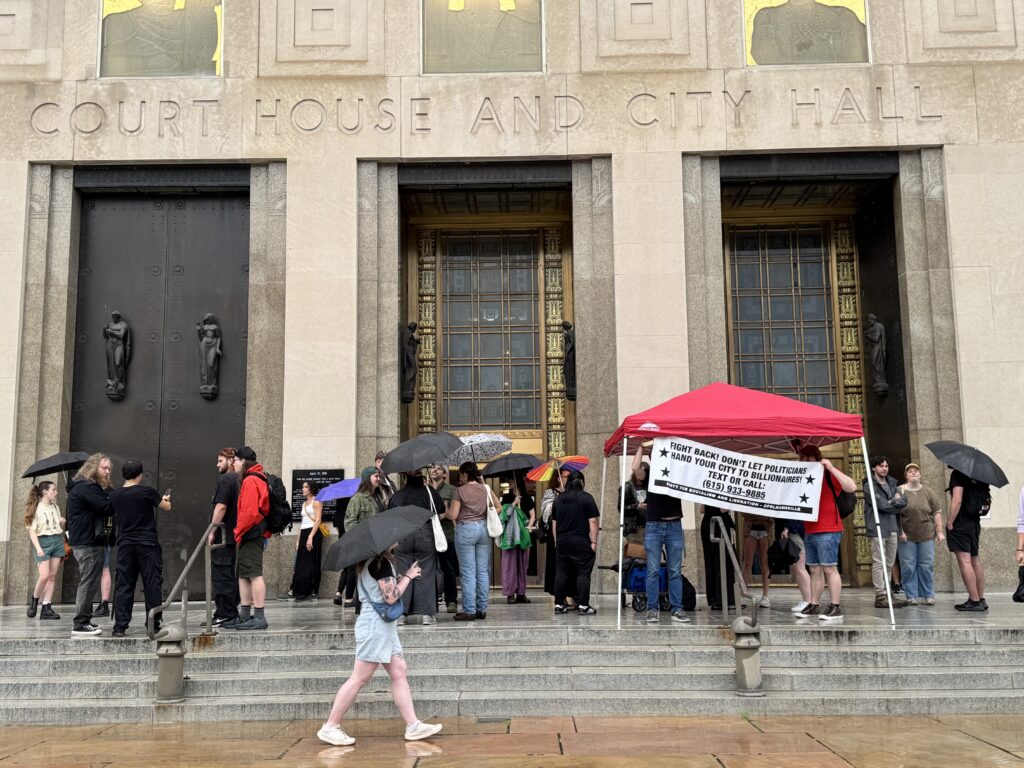
Nashville Courthouse and City Hall — Community members respond to the proposed data center moratorium, July 2026
Data centers are not ordinary buildings. They are high-impact infrastructure — and cities need a better way to evaluate them before communities are forced into crisis decisions.
Nashville's current data center debate is not just a local zoning dispute. It is a national warning sign.
In July 2026, Nashville Mayor Freddie O'Connell urged Metro Council to support data-center-specific zoning standards and a temporary pause on new data center approvals. His core concern was simple and important: Nashville's zoning code did not distinguish between a small server room and a hundred-megawatt data center campus. That gap matters because modern data centers can carry very different impacts than traditional office, warehouse, telecom, or light industrial uses.
The proposed moratorium legislation, BL2026-1448, identifies the exact categories cities are now struggling to understand: high electrical demand, backup generators, fuel storage, battery systems, substations, transformers, cooling systems, mechanical equipment, noise, vibration, lighting, stormwater impacts, security fencing, emergency-response concerns, and continuous 24-hour operations.
That list is not anti-technology. It is the beginning of responsible infrastructure governance.
LegacyGrid AI believes data centers can be valuable public, institutional, and economic assets. They can support AI, healthcare, education, research, workforce development, government services, emergency resilience, and regional competitiveness. But that value only becomes real when projects are reviewed as infrastructure systems, not simply as buildings.
A city should not have to choose between "approve everything" and "block everything." A better path is possible.
The Core Problem
The Zoning Code Was Not Built for Modern AI Infrastructure
For decades, many local zoning codes treated data centers as office, telecom, warehouse, utility, or industrial uses. That may have worked when the facility was a small server room or modest back-office computing site.
It does not work for modern AI infrastructure.
A large-scale data center may operate continuously, draw major electrical load, require utility upgrades, use intensive cooling systems, include battery energy storage, rely on backup generation, affect stormwater and emergency planning, and create land-use conflicts near sensitive sites.
That is why the mayor's statement matters. His message was not only about one proposed parcel near the Nashville Zoo. It was about a structural gap in local government review: without clear definitions, cities may be forced to evaluate high-impact digital infrastructure under land-use categories never designed for that level of power, mechanical intensity, or operational complexity.
This is where communities get stuck. Residents ask questions about noise, power, water, generators, wildlife, air quality, public benefit, jobs, traffic, and long-term land use. Developers respond with broad assurances. City staff are left to interpret outdated code. Elected officials face public pressure. The result is a crisis decision instead of a structured review.
That is not fair to residents, developers, utilities, institutions, or city leaders.

Public engagement is essential when high-impact infrastructure enters a community without a clear review framework.
Classification First
Data Centers Should Be Classified by Impact, Not Just by Name
The first step is classification. A city should not regulate every data center the same way. A small enterprise server room, a moderate colocation facility, and a high-density AI campus are not the same land use.
LegacyGrid AI recommends that cities classify data centers using measurable factors, including planned electrical demand, IT load and facility load, site acreage and building scale, cooling method, water use and water source, backup generation, battery energy storage, substation or transformer requirements, mechanical-equipment intensity, noise and vibration profile, operating hours, and proximity to sensitive uses.
Sensitive uses should include residential neighborhoods, parks, schools, hospitals, greenways, zoological institutions, public gathering spaces, university campuses, and community-serving institutions.
The question should not be, "Is this a data center?" The better question is: What type of data center is this, what infrastructure does it require, and what impacts must be reviewed before approval?
The 12 Questions
What Every City Should Ask Before Approval
A responsible review framework should require developers to answer clear questions before a project advances. LegacyGrid AI recommends twelve:
1. What is the actual power demand? The city should require disclosure of projected IT load, total facility load, phased load growth, peak demand, and whether the power path is studied, reserved, contracted, or merely requested.
2. What utility upgrades are required? The review should identify substations, transformers, transmission or distribution upgrades, interconnection timing, interim power, and who pays for infrastructure improvements.
3. How will the facility be cooled? Cities should understand whether the project uses air cooling, liquid cooling, chillers, dry coolers, evaporative cooling, cooling towers, hybrid systems, or another method.
4. How much water will the project use? The review should include annual water use, peak-day water use, water source, water treatment, discharge, drought exposure, and whether reclaimed or non-potable water is feasible.
5. What backup generation will be used? The city should know whether the project uses diesel generators, gas generation, battery systems, fuel cells, or other backup systems. Fuel storage, testing, runtime, emissions, noise, and emergency response should be disclosed.
6. Is battery energy storage included? Battery systems may improve resilience and reduce generator dependence, but they require safety planning, fire coordination, chemistry disclosure, monitoring, and emergency-response procedures.
7. What are the noise and vibration impacts? Mechanical equipment, cooling systems, transformers, generators, and 24-hour operation can create impacts very different from a normal commercial building.
8. What are the lighting, security, and visual impacts? Security fencing, lighting, truck access, cameras, walls, and utility equipment should be evaluated against nearby public spaces and neighborhoods.
9. What happens during emergencies? The review should cover fire, power outages, backup operation, battery incidents, fuel events, severe weather, cybersecurity events, and emergency access.
10. What public or institutional benefit is created? A project should explain its value beyond tax base — workforce pathways, local hiring, education partnerships, compute access, community resilience, public infrastructure contributions, and transparent reporting.
11. What claims are being made? If a developer claims a project is sustainable, efficient, water responsible, community beneficial, resilient, or low impact, those claims should be tied to measurable evidence.
12. What conditions should follow the project after approval? Approval should not end the review. Cities should require monitoring, reporting, material-change disclosure, and enforcement mechanisms.
On Moratoriums
A Temporary Pause Can Be Responsible Governance
A temporary pause can be responsible when a city lacks the framework needed to evaluate a new infrastructure class. Nashville's proposed moratorium is aimed at pausing approvals while data-center-specific rules are considered. The bill language recognizes that data centers may be appropriate in some locations if properly defined, reviewed, conditioned, buffered, and regulated — but may be incompatible near certain sensitive uses without appropriate standards.
The issue is not whether data centers are good or bad. The issue is whether a city has the tools to distinguish between a responsible project and a poorly disclosed project, an appropriate site and a sensitive site, a credible infrastructure plan and a marketing claim, and a real community benefit and a talking point.
A thoughtful moratorium should not become a permanent anti-development position. It should become a bridge to better rules.
The LegacyGrid AI Position
A Practical Data Center Readiness Framework for Cities
LegacyGrid AI supports responsible AI infrastructure. We also believe communities deserve clear standards before high-impact data center projects are approved. The Nashville debate shows the need for a framework that evaluates data center development across energy, cooling, water, resilience, utility coordination, safety, governance, public transparency, institutional value, and community impact.
LegacyGrid AI's EDC framework is designed around that exact systems view. EDC means Efficient Data Center — and in LegacyGrid's view, an efficient data center is not merely a facility with a good power-usage number. It is an infrastructure system that uses energy, water, land, utility capacity, technology, capital, and community trust responsibly.
LegacyGrid AI recommends that cities develop a readiness framework with six layers: Data Center Classification, Required Developer Disclosures, Sensitive-Site Review, Infrastructure Impact Review, Claims Integrity, and Monitoring and Accountability.
Why This Matters
Nashville Will Not Be the Last City to Face This
As AI infrastructure expands, more cities will confront proposals that move faster than local zoning codes, utility planning processes, and public understanding. The cities that succeed will not be the ones that simply approve everything or ban everything.
The cities that succeed will be the ones that build a serious review process. They will define what kind of data center belongs where. They will require evidence. They will protect sensitive sites. They will coordinate with utilities. They will demand transparency. They will connect infrastructure growth to workforce, institutional, and community value.
Nashville is not just debating a data center. Nashville is showing the country why AI infrastructure needs a new public-review framework.
Continue Reading
The full EDC Report article on Nashville's data center readiness framework goes deeper on the six-layer framework, developer disclosure requirements, and what responsible governance looks like in practice.
Nashville's moratorium is the exact scenario LegacyGrid AI's EDC Framework is designed to prevent — and to navigate when it arrives. The five-layer LGAI methodology evaluates power self-sufficiency, water sourcing, community protection, financial accountability, and workforce benefit before any AI infrastructure partnership is proposed. Cities and institutions that have completed an LGAI readiness assessment are not starting from zero when a data center developer arrives. They have documented evidence, structured questions, and enforceable guardrails ready before the first conversation begins.
For HBCUs in data center corridors — including the Waller County corridor near PVAMU — the time to build the evaluation framework is before the moratorium, not after. LegacyGrid AI offers AI Readiness Assessments and EDC Framework evaluations for institutions and communities considering AI infrastructure partnerships.
REQUEST AN ASSESSMENT →