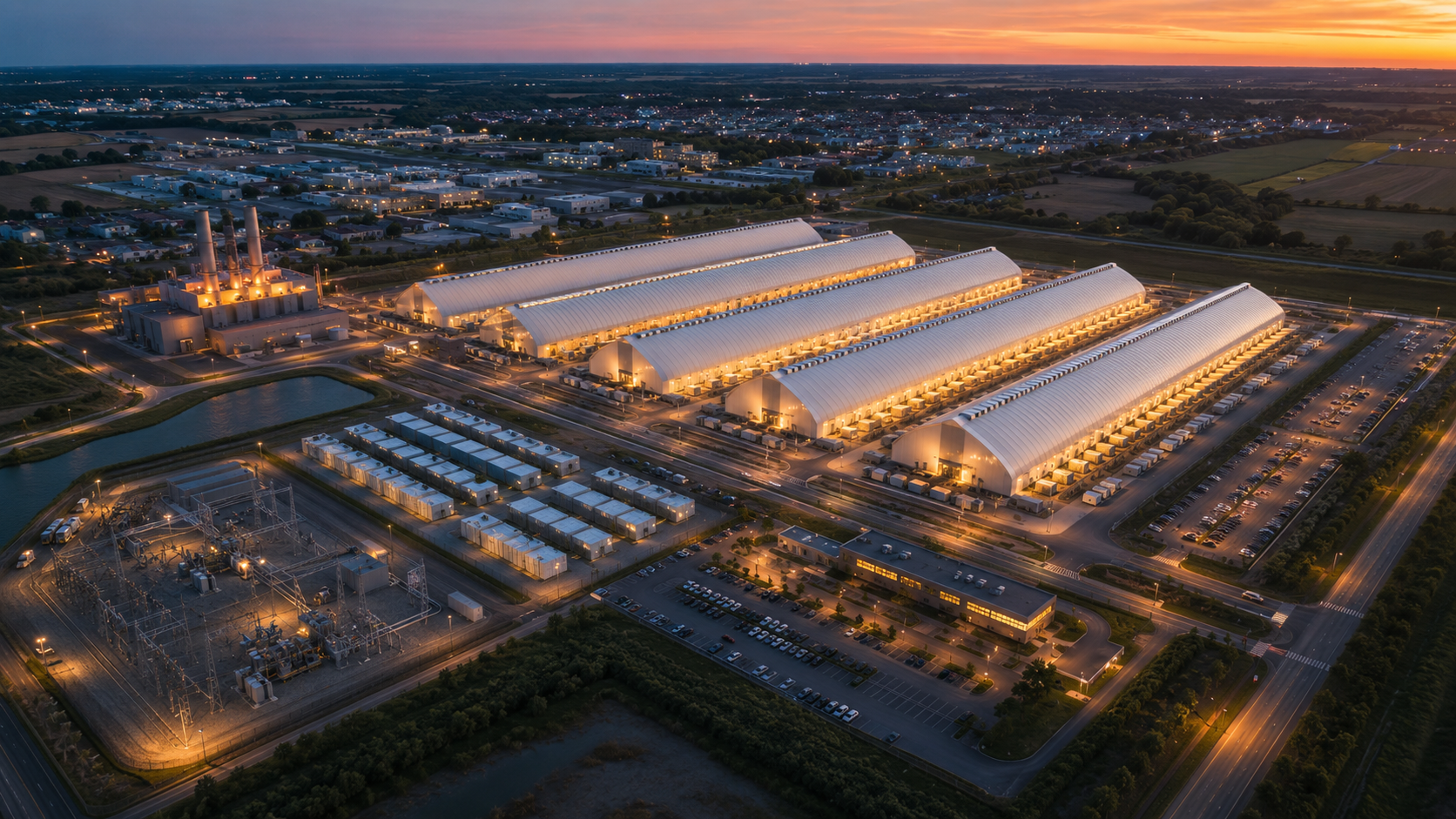
Serverfarm-First Strategy · Institution-Side Advisory · No Upfront Cost to Schools
5
Framework Layers
6
Execution Phases
$0
Upfront Cost to Schools
100%
Institution-Side Advisory
01
Entry Point
AI Readiness Assessment
The front door to every LegacyGrid engagement. Before any infrastructure conversation begins, LegacyGrid scores the institution's AI strategy, student training programs, faculty and staff AI adoption, governance readiness, and community outreach capacity.
This assessment determines which path forward makes sense — AI hub, data center feasibility, workforce program, or a combination. Outputs include an AI strategy score, readiness gap analysis, recommended model, risk identification, and a board-facing summary.
02
Site Evaluation
Infrastructure Feasibility Study
Not every campus is the right fit for AI infrastructure development. LegacyGrid evaluates whether a site's institutional characteristics, infrastructure positioning, and community context support a responsible partnership at the scale being considered.
For Phase 1, PVAMU in Waller County is the first feasibility target based on its land position, institutional AI readiness, workforce pipeline, and corridor proximity. Outputs include a site readiness assessment, utility and connectivity validation plan, and a partner fit evaluation.
03
School Protection
Deal Structure & Guardrails
This is where LegacyGrid protects the school. Every deal must include enforceable revenue terms, student benefit requirements, compute access provisions, community benefit obligations, environmental review commitments, data governance protections, and exit terms.
LegacyGrid provides RFP templates, partner checklists, and board-facing summaries. The difference between a weak deal and a LegacyGrid deal is the presence of clawbacks, restoration obligations, and a decommissioning plan that protects the institution long after the deal closes.
LegacyGrid AI's advisory services do not constitute real estate brokerage. LegacyGrid AI does not represent either party in a real estate transaction, does not hold or negotiate title to real property, and does not act as a licensed real estate broker or agent. Institutions should engage their own licensed real estate counsel for transaction execution.
04
Campus Value
AI Hub & Workforce Program
The campus AI hub is not just a data center. It includes AI literacy programs, data center operations curriculum, cybersecurity training, electrical and HVAC maintenance pathways, student internships with Serverfarm, AI governance research, community AI workshops, and small business support.
Kiwi can serve as an optional supporting access layer for immediate campus AI value. Outputs include AI literacy curriculum, data center operations training, cybersecurity pathways, a student internship program, and community AI workshops.
05
Accountability Layer
Impact Dashboard & Compliance
Promises made in AI infrastructure deals must be tracked and enforced. LegacyGrid's impact dashboard monitors lease payments, workforce outcomes, compute credit delivery, vendor participation, environmental reporting, community benefit compliance, and annual escalator payments.
This is the accountability layer that separates a LegacyGrid deal from a passive landlord arrangement. Institutions receive ongoing reporting on every material commitment made at signing.
From Concept to Grid-Connected
A Staged Path That Turns the Model Into an Executable Program
01
Phase 01: Qualify
Evaluate institutional readiness, site characteristics, and infrastructure positioning. Not every campus is the right fit — and knowing that early protects everyone's time and resources.
02
Phase 02: Control
Establish institutional site control through the appropriate agreement structure. Under Texas SB 6, executed site control is the prerequisite for entering the ERCOT interconnection process.
03
Phase 03: Interconnect
Enter the SB 6 process: intermediate agreement, feasibility study, and execution within the statutory deadlines. This is the most time-sensitive phase — queue position matters.
04
Phase 04: Partner
Structure the infrastructure partnership agreement. Preserve institutional ownership and long-term upside. Define the full set of school benefit obligations — workforce, compute access, community impact, and governance rights.
05
Phase 05: Build & Operate
The operator deploys capital, compute, and cooling. A tiered, secured, resilient facility comes online. LegacyGrid's impact dashboard monitors compliance from day one.
06
Phase 06: Workforce
Stand up the campus training pipeline. Local jobs, durable community benefit, and a student-to-career pathway that outlasts any single infrastructure deal.

Ready to explore?
Ready to Explore the Model for Your Institution?
LegacyGrid works with institutions at every stage — from initial curiosity to full implementation. Start with a conversation.
Disclosure: LegacyGrid is an independent advisory firm. No binding agreements exist with any institution, university system, or data center developer referenced on this site. Read our full transparency statement →