AI Data Center Power Is Becoming Texas' New Infrastructure Test
Texas is becoming a proving ground for the next phase of AI infrastructure: data centers that bring their own power. The strategy may speed deployment, but it also raises harder questions about permitting, public trust, grid planning, and engineering accountability.
LegacyGrid AI Research · August 5, 2026 · 10 min read
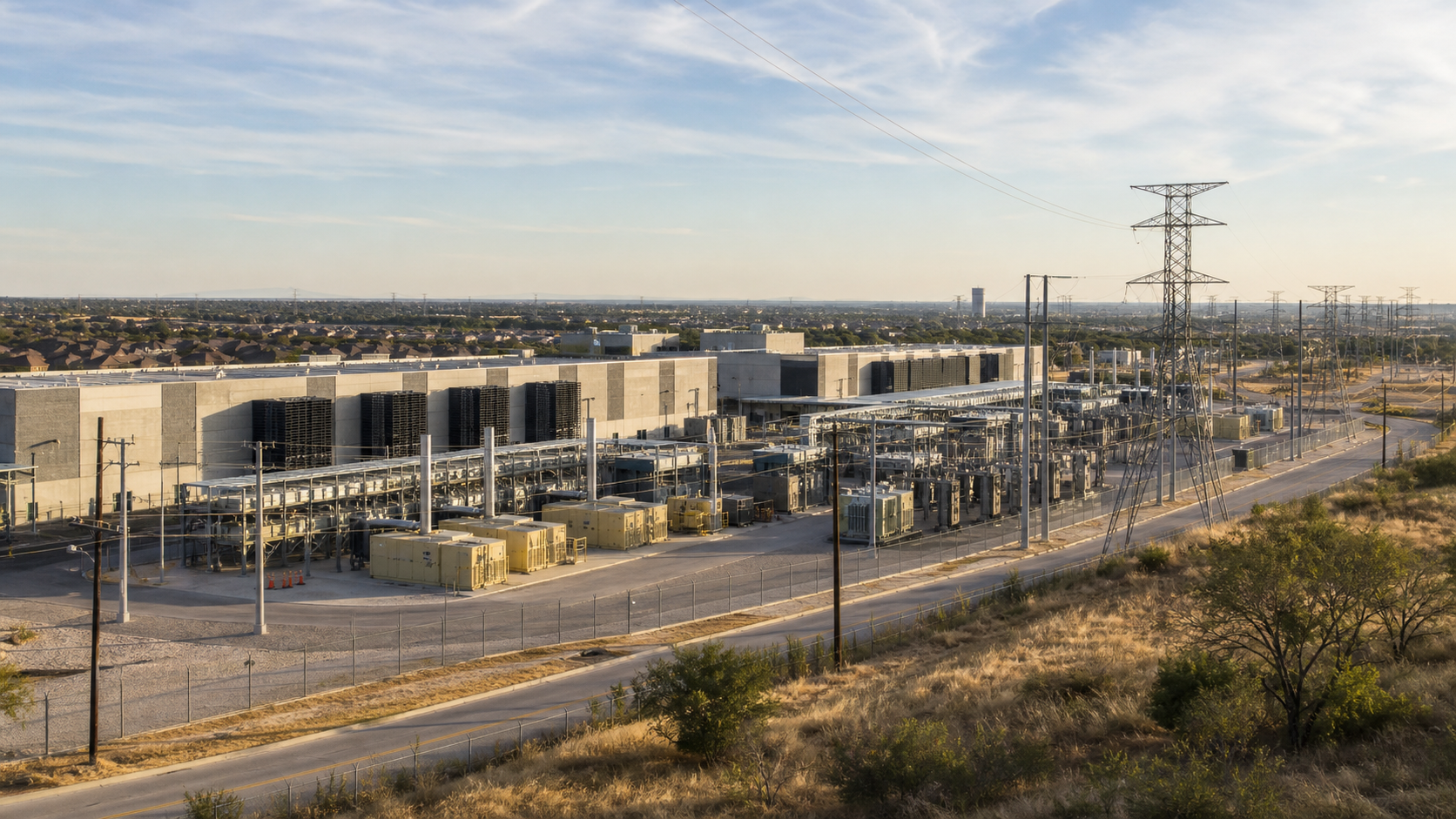
AI infrastructure is increasingly being planned around power availability, not just land and fiber.
Across Texas, the AI buildout is no longer an abstract debate about cloud capacity. It is showing up as steel, substations, turbines, diesel backup generators, public hearings, and neighbors asking what exactly is being built across the road. The newest flashpoint is San Antonio's far west side, where two data center projects associated with Vantage Data Centers and on-site power provider VoltaGrid have drawn scrutiny from homeowners and environmental groups over air permitting and emissions oversight.
The conflict is bigger than one company or one county. AI data center power has become one of the defining infrastructure questions of 2026: how to bring massive compute online fast enough for industry demand while still giving communities, utilities, regulators, and operators a clear view of the costs and controls. Texas is testing that question in real time, and the answer will matter far beyond Texas.
The New Geography of AI Data Center Power
The old data center story was mostly about fiber, land, tax incentives, and utility access. Those factors still matter, but power has moved to the center of the site-selection map. The U.S. Energy Information Administration reported in March 2026 that electricity demand has risen steadily since 2020 after more than a decade of little change, with data center electricity use helping drive that growth. The Department of Energy has likewise described data center deployment, partly driven by AI applications, as a significant factor in near-term electricity demand growth.
In Texas, that pressure is visible at grid scale. ERCOT's April 2026 preliminary long-term forecast projected approximately 367,790 megawatts of demand in the ERCOT region by 2032, compared with an all-time peak demand of 85,508 megawatts recorded on August 10, 2023. ERCOT cautioned that the forecast was not a prediction of what will be built, but it reflected a wave of large load requests from data centers, crypto mining, industrial operations, and oil and gas processes.
That pressure helps explain the rise of "bring your own power" strategies. Instead of waiting years for grid upgrades or interconnection studies, some developers are pairing data centers with dedicated natural gas generation, batteries, or large fleets of backup engines. From an engineering standpoint, the logic is understandable: hyperscale AI loads need reliability, fast delivery, redundancy, and predictable capacity. From a civic standpoint, the question is whether power systems that look like utility-scale assets should be reviewed with utility-scale transparency.
What Is Happening on San Antonio's West Side
The San Antonio dispute became widely visible after local reporting showed residents reacting to large data center-related construction near neighborhoods. Public records confirm that TCEQ scheduled a May 28, 2026 notice-and-comment hearing for Vantage Data Centers TX21, LLC's initial federal operating permit, Permit No. O4790, for the Vantage Data Center TX2 in Bexar County. TCEQ's current Title V applications list also shows Vantage Data Centers TX11, LLC with Permit No. O4791 and Vantage Data Centers TX21, LLC with Permit No. O4790, both tied to Bexar County and technically complete applications dated July 17, 2025.
The technical filings show why the controversy is complicated. TCEQ's statement of basis for Vantage Data Center TX2 says Vantage confirmed the facility as a Title V major source due to nitrogen oxides after Bexar County's nonattainment status changed. Yet the same statement lists Prevention of Significant Deterioration and Nonattainment New Source Review as "No" and Minor NSR as "Yes." For TX11, TCEQ's statement of basis identifies nitrogen oxides as the major pollutant while also listing Minor NSR as applicable and NNSR as not applicable.
Environmental groups including Public Citizen, Sierra Club, and the Environmental Integrity Project have argued that the data center campuses and dedicated power assets should be evaluated together for major-source permitting purposes. Their allegation — not yet adjudicated in court — is that separating the data center and generation pieces understates the combined pollution profile. Reporting by multiple outlets has described a 60-day notice of intent to sue involving Vantage and VoltaGrid.
"Residents do not experience a campus as separate corporate entities, permit numbers, or equipment classes. They experience lights, sound, exhaust stacks, truck traffic, emergency engines, and uncertainty."
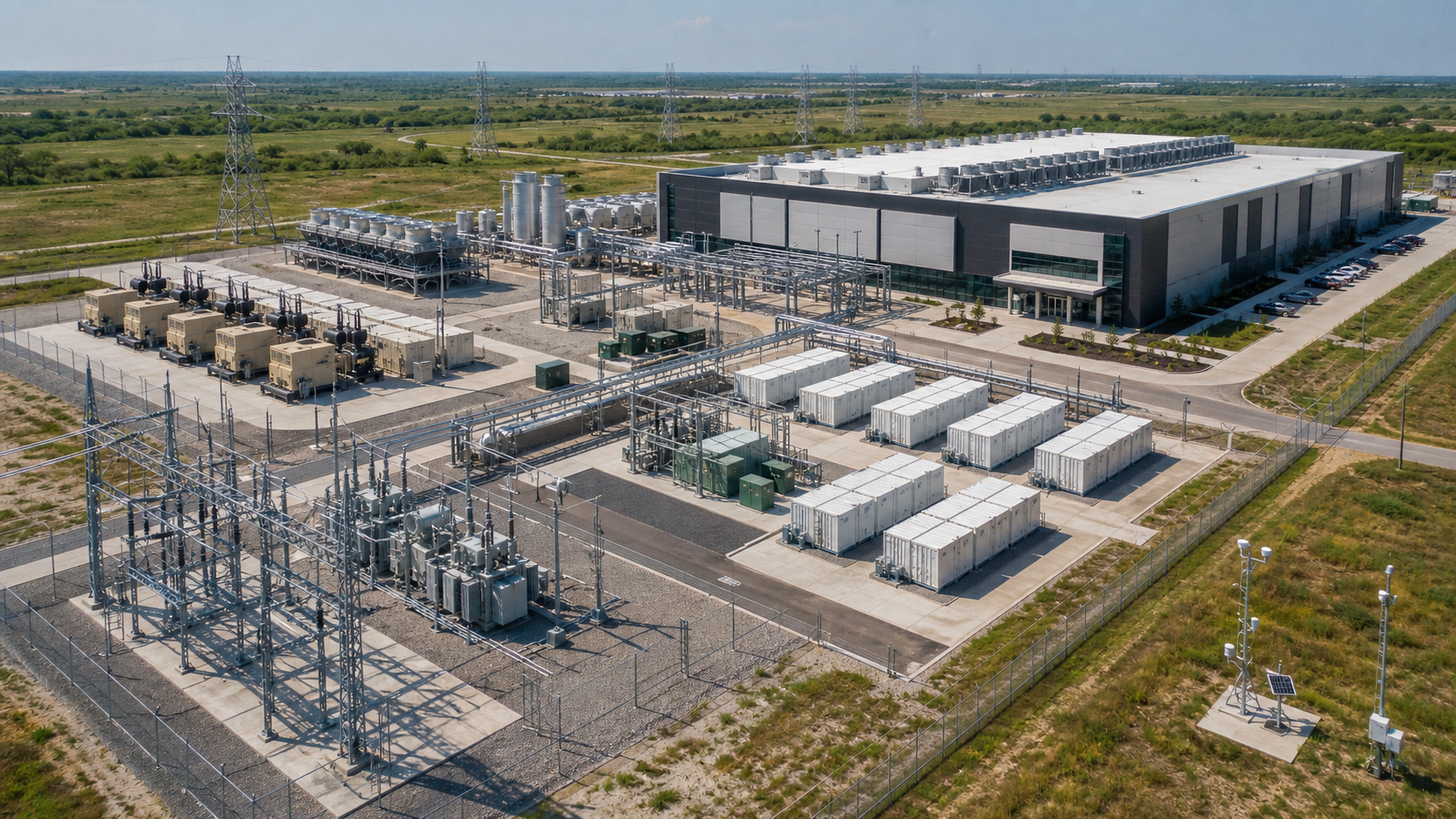
Modern data center planning now joins uptime, grid impact, emissions, and public accountability in one design problem.
Why Ozone Status Changes the Stakes
Bexar County is not starting from a clean regulatory slate. TCEQ's San Antonio attainment-status page lists Bexar County as serious nonattainment for the 2015 eight-hour ozone standard, with an attainment deadline of September 24, 2027. Ground-level ozone forms when pollutants such as nitrogen oxides and volatile organic compounds react in sunlight, and EPA states that ozone exposure can aggravate respiratory conditions, increase asthma attacks, and make breathing more difficult, especially for children, older adults, outdoor workers, and people with asthma.
That context is why nitrogen oxides matter. Diesel engines and natural gas combustion can emit nitrogen oxides. A backup generator that runs rarely is one risk profile. Dozens of generators, frequent testing, or a dedicated power plant beside a fast-growing load is a different planning problem. Regulators may still determine that a facility meets applicable limits, but in a nonattainment area the public will naturally ask how cumulative emissions are being counted and who is accountable if assumptions change.
EPA's Title V guidance says major sources generally need operating permits when actual or potential emissions meet major-source thresholds, with lower thresholds applying in nonattainment areas for the relevant pollutant. Title V itself does not authorize new construction; it consolidates applicable requirements into an operating permit. That distinction can be lost in public debate, but it is essential. Communities want to know whether the right preconstruction review happened before equipment arrived, not only whether an operating permit file exists afterward.
The Engineering Lesson: Reliability Cannot Be Isolated From Permitting
For data center engineers, reliability has always been nonnegotiable. AI workloads raise the bar further because training clusters and inference platforms depend on high-density, continuous power. That requirement pushes design teams toward layered redundancy: utility feeds, substations, UPS systems, batteries, generators, microgrids, and sometimes dedicated combustion generation.
But the new lesson is that reliability engineering and public-interest engineering are now the same conversation. A power architecture that is technically resilient but publicly opaque can create schedule risk, litigation risk, reputational risk, and political risk. A design that can explain its emissions boundaries, operating assumptions, testing limits, emergency-use definitions, noise controls, water profile, and grid interaction is stronger than one that treats those questions as afterthoughts.
"The stronger play is not merely to get power quickly. It is to build infrastructure that can stand up to utility review, regulator review, investor review, and neighborhood review at the same time."
This is where LegacyGrid AI naturally fits into the market conversation. As an AI infrastructure systems engineering and consulting firm, LegacyGrid AI's relevance is not in taking sides on one permit dispute. It is in helping technical teams plan facilities where power, compliance, resilience, and community expectations are modeled early — before equipment arrives and before permits become contested.
That means better front-end diligence: realistic load forecasts, clearer source aggregation analysis, cleaner emissions modeling, backup-generation operating policies, transparent equipment inventories, and a documented path for cleaner capacity over time. AI infrastructure will keep growing. The operators that treat energy strategy as a board-level risk and an engineering discipline will have the better chance of growing without avoidable friction.
What Texas Is Signaling to the Industry
Texas leaders have sent a clear message that data centers must account for their impact on the electric system and surrounding communities. In June 2026, Governor Greg Abbott directed the Public Utility Commission of Texas and ERCOT to take steps to shield residential ratepayers from data center infrastructure costs, require data centers to fund needed electric infrastructure, and consider water-efficient cooling, accurate energy and water reporting, setbacks, and noise reduction. ERCOT and PUCT also approved a Batch Zero process for large electricity users of 75 megawatts or more, designed to study large requests together rather than one project at a time.
Those moves do not settle the San Antonio permitting dispute. They do signal that the political tolerance for opaque large-load growth is narrowing. Texas still wants economic development, and data centers are part of the state's technology future. But the old bargain of speed first, details later is becoming harder to defend when a single campus can resemble a power project, an industrial facility, and a critical digital asset at once.
The constructive path is not anti-data center. It is pro-discipline. AI infrastructure needs power, and Texas has the energy culture, land base, and market experience to help build it. But the industry will need to speak in complete infrastructure terms: megawatts, emissions, water, noise, interconnection, equipment duty cycles, operating limits, and community benefits. That is the vocabulary of durable projects.
For technology leaders, the takeaway is direct. The AI race will not be won only by securing chips or land. It will be won by organizations that can deliver compute capacity with credible power plans. In 2026, that means engineering the facility and engineering the permission to operate with equal seriousness.
The Future of AI Data Center Power Will Be Built in Public
AI data center power is no longer hidden behind the walls of server halls. It is visible in gas turbines, generator yards, transmission studies, operating permits, and public meetings. San Antonio's west-side dispute shows what happens when the physical footprint of AI arrives faster than public understanding. The facts will continue to be tested through regulatory processes and, possibly, litigation. The larger lesson is already clear.
The next generation of AI infrastructure must be engineered for trust as well as uptime. That requires better planning, better disclosure, and a more integrated view of power, emissions, water, grid impact, and neighborhood context. Companies that do that work early will not just build data centers. They will build the operating credibility that AI now requires.
Frequently Asked Questions
Why are AI data centers building their own power plants?
Some AI data centers need large amounts of reliable electricity faster than local grids can provide through traditional interconnection timelines. On-site generation can improve speed and resilience, but it also creates permitting, emissions, noise, and community-review questions.
What is the controversy around the San Antonio data centers?
Environmental groups allege that data center and on-site generation assets associated with Vantage Data Centers and VoltaGrid should be evaluated together under more stringent major-source air permitting rules. TCEQ records show Title V operating permit activity for Vantage sites in Bexar County, while the dispute centers on the scope and adequacy of preconstruction review.
Why does Bexar County's ozone status matter for AI data centers?
Bexar County is classified by TCEQ as serious nonattainment for the 2015 eight-hour ozone standard. Because nitrogen oxides contribute to ground-level ozone formation, combustion sources near San Antonio receive closer attention from residents and environmental advocates.
What did Texas Governor Abbott direct regarding data center power costs?
In June 2026, Governor Greg Abbott directed the Public Utility Commission of Texas and ERCOT to shield residential ratepayers from data center infrastructure costs, require data centers to fund needed electric infrastructure, and consider water-efficient cooling, accurate energy and water reporting, setbacks, and noise reduction.
What is ERCOT's Batch Zero process for large electricity users?
ERCOT and PUCT approved a Batch Zero process for large electricity users of 75 megawatts or more, designed to study large load requests together rather than one project at a time. This helps manage the wave of data center and industrial load requests on the Texas grid.
Related Articles
Policy
AI Data Centers Should Pay Their Own Way — But That Is Only the Beginning
Strategy
Nashville Data Center Readiness Framework
EDC Report
Power Is the Project: Data Center Feasibility & Energy Strategy
EDC Report
Battery Storage Strengthens Power Strategy — It Does Not Replace the Grid
Services
Power & Grid Strategy — LegacyGrid AI Services